
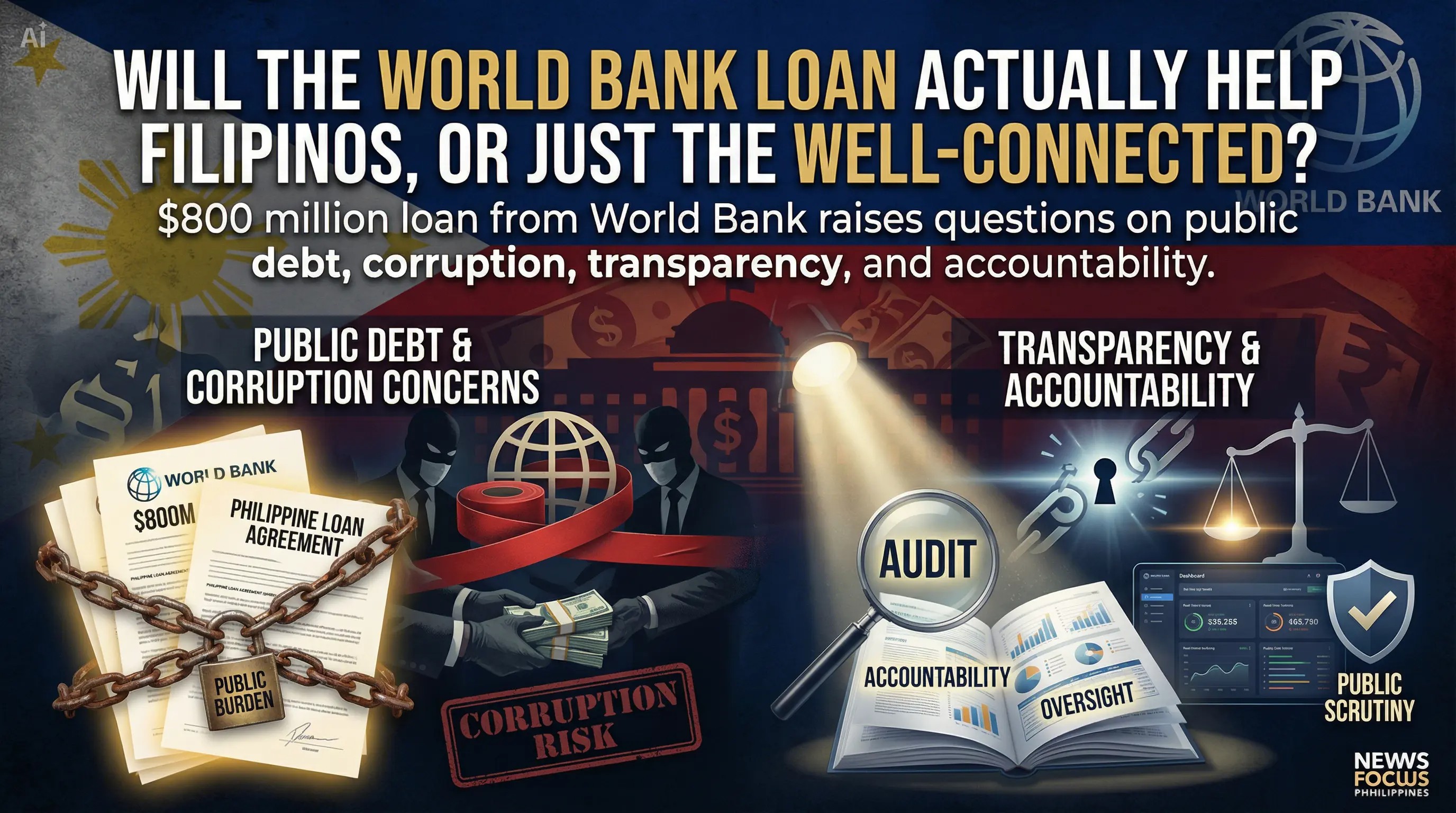
The World Bank approved an $800 million Development Policy Loan for the Philippines on March 12. Press releases from Malacañang celebrated it as a "strong vote of confidence" in the country's economic direction. Finance Secretary Frederick Go called it a testament to the administration's "firm commitment to fiscal discipline."
It sounds impressive. But for ordinary Filipinos who have watched billions disappear into ghost projects, overpriced contracts, and unaccounted confidential funds, the announcement raises a more uncomfortable question: who is this loan actually for?
What Kind of Loan Is This?
This is not a loan for a specific bridge, road, or hospital. It is a Development Policy Loan (DPL) — a form of budget support that goes directly into the government's general fund. There is no single infrastructure project to point to. No ribbon-cutting ceremony where you can check whether the structure was actually built.
In exchange for the funds, the government commits to implementing a set of policy reforms across three areas: fiscal management, improving the business climate, and building workforce skills. The World Bank releases the money when it determines the Philippines has met its prior action requirements — typically by passing laws, issuing executive orders, or amending regulations.
On paper, this is a reasonable mechanism. Policy-based lending is designed to support systemic reform, not just physical infrastructure. But in a country with a long and documented history of policy compliance on paper and elite capture in practice, the design of this loan creates real accountability gaps.
The DPWH Problem Nobody Solved
Before celebrating this new loan, it is worth remembering what happened with the last major scandal involving public funds.
The Commission on Audit flagged anomalies in DPWH spending amounting to hundreds of billions of pesos. Civil society groups, opposition legislators, and even some administration allies raised alarm. The public was outraged.
And then? The administration weathered it. Congressional investigations stalled or were controlled by administration allies. No senior official faced serious legal consequences. The Ombudsman, as has become tradition, moved at geological speed. The scandal was eventually buried under the news cycle.
This is the governance environment into which $800 million in fresh budget support is now being released.
Confidential Funds: ₱4.5 Billion and Counting
The Marcos administration has allocated billions in confidential and intelligence funds with minimal public disclosure. When asked to account for how these funds were spent, the standard response from Malacañang has been to invoke national security.
This is the same administration that is now promising the World Bank "fiscal discipline" and "efficiency of public spending." The contradiction deserves scrutiny, not applause.
How World Bank Loans Actually Work — and Where They Fall Short
To be fair, the World Bank is not naive. The DPL mechanism requires the Philippine government to fulfill specific reform conditions before funds are disbursed. These are called prior actions, and they typically involve verifiable policy changes: amending a law, issuing a regulation, restructuring a government process.
But there are structural limits to what the World Bank can enforce:
First, once the money is disbursed into the general fund, it becomes indistinguishable from all other government revenues. There is no earmarking. There is no project-level audit trail. The World Bank cannot track whether a peso from this loan went to a legitimate workforce training program or to an inflated procurement contract.
Second, the World Bank has institutional incentives to maintain its relationship with the Philippine government. Declaring a borrower non-compliant is costly — diplomatically and operationally. This creates a bias toward finding ways to certify compliance rather than withholding disbursements.
Third, the reforms required as prior actions tend to be structural and legislative — the kind of thing the Philippine government can deliver on paper while circumventing in practice. Passing an anti-red tape amendment is easy. Actually reducing red tape in a system run by discretion and connections is another matter entirely.
The Real Question: Who Will Actually Benefit?
The World Bank frames this loan as supporting "more and better-paying jobs" for Filipinos, especially women and youth. That is a worthy goal. If the fiscal reforms reduce wasteful spending and redirect resources to public services, if the business climate reforms actually make it easier for small entrepreneurs to operate rather than just large conglomerates, and if the workforce development programs reach communities that need them — then this loan would be money well spent.
But Philippine political history offers a sobering pattern. Large infusions of development finance, without strong independent oversight, tend to benefit those who are already connected. Construction companies with ties to the ruling coalition win the contracts. Implementation is assigned to agencies whose leadership was chosen for political loyalty, not competence. And the reforms promised to international lenders are performed at the level of optics, not substance.
The administration has until 2028. It controls the House of Representatives. The Ombudsman and courts move slowly. There is no functioning opposition with enough leverage to compel meaningful accountability in the short term.
Skepticism Is Not Cynicism
To question how this loan will be used is not to be anti-development or anti-Philippines. It is to take seriously what governance accountability actually requires.
The World Bank should be asked: What specific measurable outcomes will determine whether this loan achieved its purpose for ordinary Filipinos? What happens if the fiscal reforms produce law but not practice? What independent Philippine civil society mechanisms will be empowered to audit implementation?
And the Marcos administration should be asked the same questions it has never adequately answered: Where did the confidential funds go? Who is accountable for the DPWH anomalies? Why should Filipinos believe that this time, public resources will be spent on the public?
Eight hundred million dollars is a significant sum. It represents a bet by the World Bank that the Philippines, under this administration, can be nudged toward better governance through conditioned lending.
Filipinos who have watched that bet fail before are not wrong to be skeptical. They are paying attention.