
The Threat That Came Before the Request
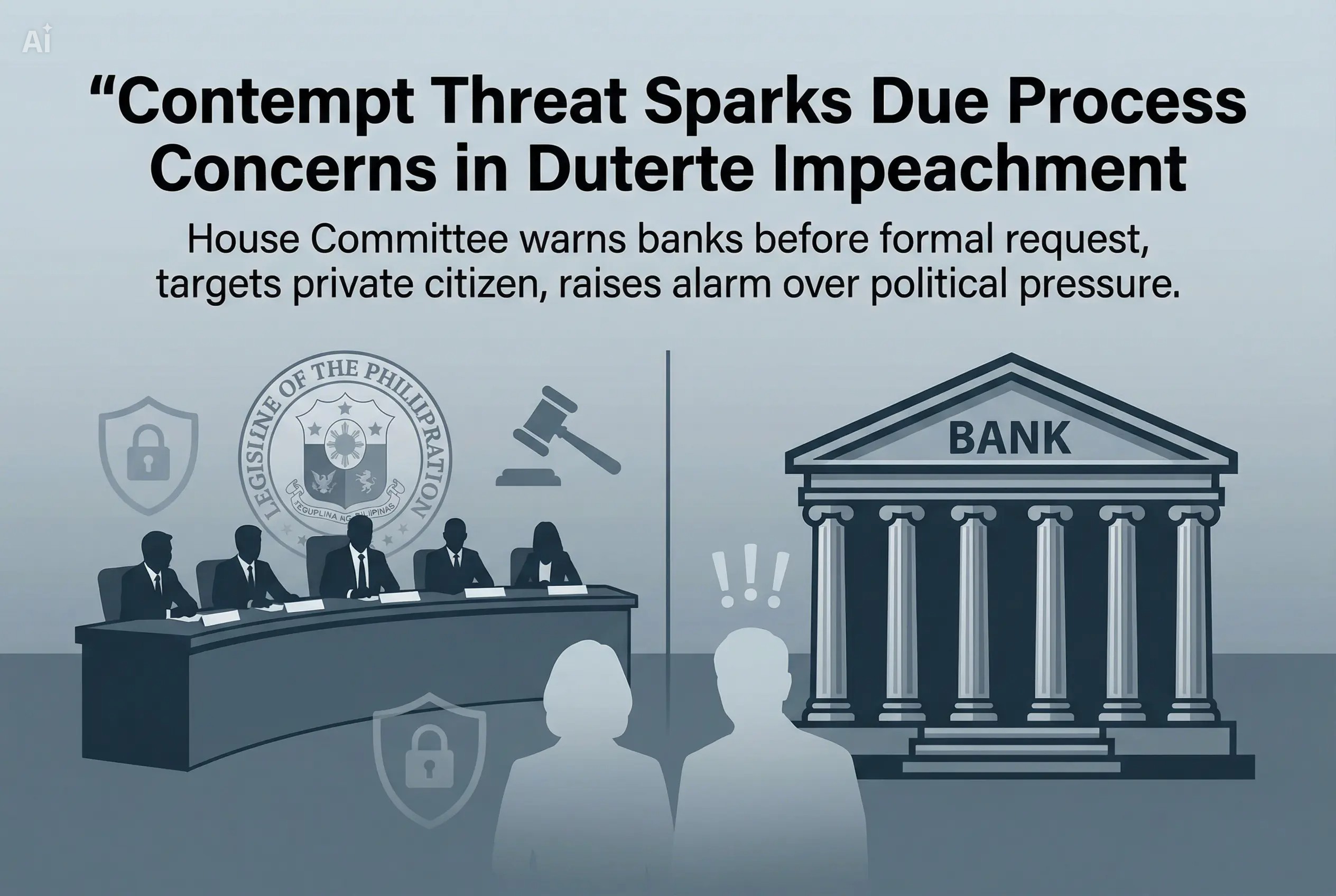
On Friday, March 20, Batangas Representative Gerville Luistro stood before reporters and warned that banks refusing to hand over the financial records of Vice President Sara Duterte and her husband, Atty. Mans Carpio, could be cited for contempt — and jailed.
There is one detail in that statement worth sitting with: no formal subpoena had even been issued yet.
The House Committee on Justice had not yet officially ordered the banks to produce anything. No bank had refused. No deadline had been missed. And yet Luistro was already announcing consequences — publicly, on camera, to the press. This is not how a credible legal process works. This is how a political pressure campaign works.
The Legal Fig Leaf
To be precise: the contempt power Luistro is citing is not fictional. During impeachment proceedings, the House committee does function with expanded quasi-judicial authority. It can issue subpoenas and, in theory, enforce them with contempt citations. That legal basis exists.
But legal basis and appropriate use of that basis are two different things entirely.
What Luistro described is a pre-emptive public warning to financial institutions — before any formal order, before any non-compliance, before any due process whatsoever. The message being sent to the banking sector is unmistakable: cooperate with us or face the threat of your officials being jailed in our facilities or in nearby detention centers. That is not the language of a judicial body pursuing evidence. That is the language of intimidation.
The Private Citizen Problem
Perhaps the most legally troubling aspect of this entire move is the inclusion of Atty. Mans Carpio — Sara Duterte's husband.
Carpio is not a public official. He is not under impeachment. He holds no government position subject to congressional oversight. He is a private citizen whose only apparent relevance to these proceedings is that he is married to the person being impeached.
Dragging a private individual's bank records into a congressional contempt threat — on the basis of marital association — is an extraordinary overreach. If this standard were applied consistently, every spouse of every official under investigation could have their financial privacy stripped away by legislative fiat. That is not accountability. That is a precedent that should alarm every Filipino, regardless of where they stand on Sara Duterte.
A Fishing Expedition by Design
The committee's decision to go after bank records at this stage — before the hearing proper has even begun on March 25 — reveals something important about the strength of the case being built against the Vice President.
In proper legal proceedings, you gather evidence to support allegations you already have reason to believe are true. Discovery and subpoenas are tools for filling in gaps in a case you've already begun to establish. What the House committee appears to be doing is the reverse: issuing threats to obtain documents in the hope that those documents will become the evidence — or at least produce something usable.
Political observers have called this a "fishing expedition," and the description is apt. Chel Diokno's push to go through the Anti-Money Laundering Council is at least legally structured — AMLC has its own mandate for investigating suspicious transactions and established protocols for sharing with authorities. Going directly to private banks via contempt threat, before even filing a formal subpoena, is the bluntest possible instrument.
The House Has Done This Before
It is worth remembering the context in which all of this is happening. The same House of Representatives that is now threatening banks to extract Sara Duterte's financial records is the institution that processed the impeachment complaints against her in what critics described as record-breaking speed — moving from filing to finding "sufficient in form and substance" in a matter of days, with minimal deliberation.
The House majority is composed overwhelmingly of allies of President Ferdinand Marcos Jr., whose political split with his former running mate Sara Duterte has been the defining drama of this administration. The impeachment proceedings — whatever their legal merit — are inseparable from that political context.
That does not mean the allegations against Duterte are false. There may well be legitimate questions about her finances and conduct in office that deserve serious scrutiny. But the manner in which this committee is proceeding — threatening institutions before asking them, targeting private citizens through their spouses, turning bank records into a fishing ground — does not serve the cause of credible accountability.
It serves the cause of political warfare dressed in legal clothing.
Due Process Is Not a Technicality
Supporters of the impeachment effort will argue that the stakes are too high for procedural hand-wringing — that Sara Duterte needs to be held accountable, and if the banks need to be pressured to make that happen, so be it.
But this argument collapses under its own weight. Due process protections exist precisely because we cannot always trust the institution applying them to be acting in good faith. A Congress dominated by one faction, pursuing the downfall of a political rival, issuing pre-emptive contempt threats against private citizens and financial institutions — this is exactly the kind of scenario where procedural safeguards matter most.
The moment we decide that the right outcome justifies abandoning the right process, we have handed every future government — including those we may not like — the same precedent to use as they see fit.
Rep. Luistro's contempt threat is not just aggressive. It is a warning sign about what kind of accountability this impeachment is actually designed to produce.
Sources: Pinas News TV, Tribune PH, Rappler, Philippine Star, ABS-CBN News