
Headline inflation eased in May, but the closely watched core measure broke through the central bank's target — and analysts say that is the number that will drive the next rate decision.
Economists expect the Bangko Sentral ng Pilipinas (BSP) to raise its benchmark interest rate by 25 to 50 basis points at its June 18 Monetary Board meeting, despite a softer-than-expected May inflation print, because underlying price pressures are still building. According to BusinessWorld, the May headline rate cooled to 6.8% from a more than three-year high of 7.2% in April — but core inflation, which strips out volatile food and energy, climbed to 4.1%, breaching the BSP's 2–4% target for the first time in two and a half years and marking the fastest core reading since December 2023.
"Our view of BSP hiking by 50 bps in the June MB meeting is unchanged as we think the lower print may only be temporary — and it is still materially above BSP's 2-4% target — as broad price pressures are still building up in the economy," Deutsche Bank Research economist Junjie Huang said in a June 8 commentary cited by BusinessWorld. He warned that May's easing was "likely short-lived," with renewed pressure looming from electricity, food and other basic goods.
The May headline figure undershot expectations sharply: it came in below the 7.9% median estimate in a BusinessWorld poll of 16 economists and the BSP's own 7.1%–7.9% forecast range. That surprise has split forecasters on the size of the hike, but not its direction. HSBC Senior ASEAN Economist Aris D. Dacanay said the softer print "removes the urgency of doing an off-cycle rate hike," noting it gave the peso some relief, but still anticipates a 50-bp move at the scheduled meeting "though noted that the downward surprise from May inflation has raised the odds of a 25-bp move."
The case for continued tightening rests on the core breach. Maybank analysts Azril Rosli and Suhaimi Ilias wrote that the climb in core inflation shows "second-round effects are gaining traction, particularly across transport, housing, utilities, and services-related sectors," even though the BSP has repeatedly said monetary policy is a blunt tool against supply-driven shocks. Patrick M. Ella, an economist at Sun Life Investment Management and Trust Corp., told One News that headline inflation "still risks breaching the double-digit mark by July or August," adding that the rising core print means "the second-round effects that the BSP is looking at will definitely carry over in the succeeding months."
Not all forecasters see prices accelerating from here. Nomura cut its 2026 average headline inflation forecast to 5.5% from 6.1%, assuming Brent crude averages $98.4 per barrel this year, and analysts Euben Paracuelles and Nabila Amani said they expect "no off-cycle meeting by BSP and only measured 25-bp hikes in each of the next three meetings starting on June 18." They cautioned, however, that an expected El Niño later this year could push food prices higher again.
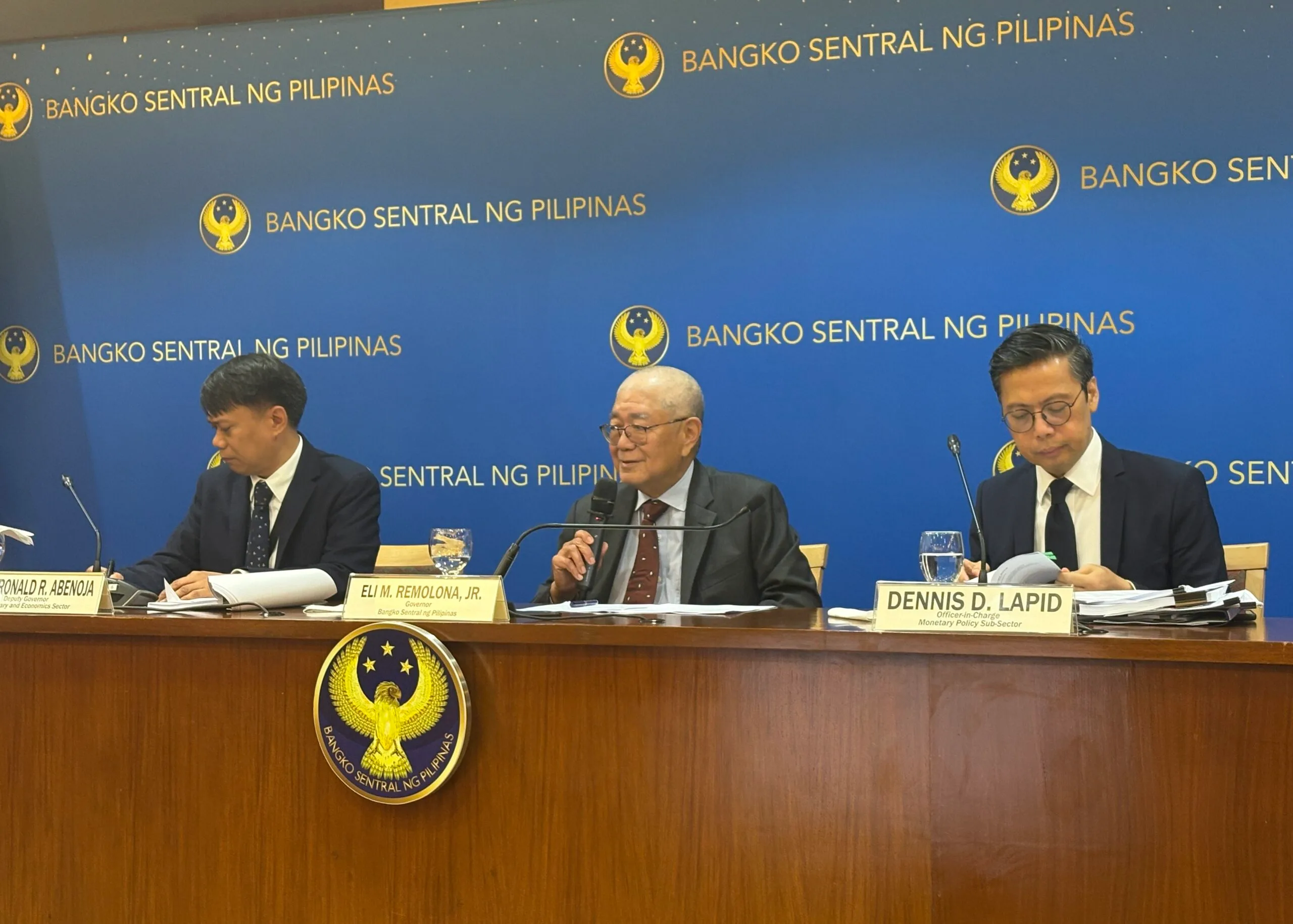
The BSP itself has signaled it is not done. BSP Governor Eli M. Remolona, Jr. said last month the board was "considering" an off-cycle tightening, citing the risk of falling "behind the curve," but indicated it may wait for the June 18 meeting to assess the May data. Last week the central bank reaffirmed its commitment to return inflation to its 3% target "using all necessary monetary policy measures."
Context
The BSP reversed more than two years of easing on April 23, raising the policy rate by 25 bps to 4.5% to contain spillover effects from a global oil-price shock linked to conflict in the Middle East. The challenge is acute because growth is weak: GDP expanded just 2.8% in the first quarter, a post-pandemic low, leaving the central bank to tighten into a slowing economy — the textbook bind of stagflation. UOB sees full-year 2026 growth at just 3.2%, down from 4.4% in 2025. The Monetary Board has four meetings left this year, on June 18, Aug. 27, Oct. 22 and Dec. 17. For households, the practical stakes are direct: higher policy rates raise borrowing costs even as elevated core inflation keeps eroding real incomes, particularly for the lowest-earning families the BSP has said it is watching most closely.
Sources
- BusinessWorld, "Jumbo BSP rate hike still likely as broad price pressures linger" by Katherine K. Chan (June 9, 2026) — bworldonline.com
- BusinessWorld, "Further BSP hikes seen despite tepid economy" by Katherine K. Chan (June 7, 2026) — bworldonline.com