
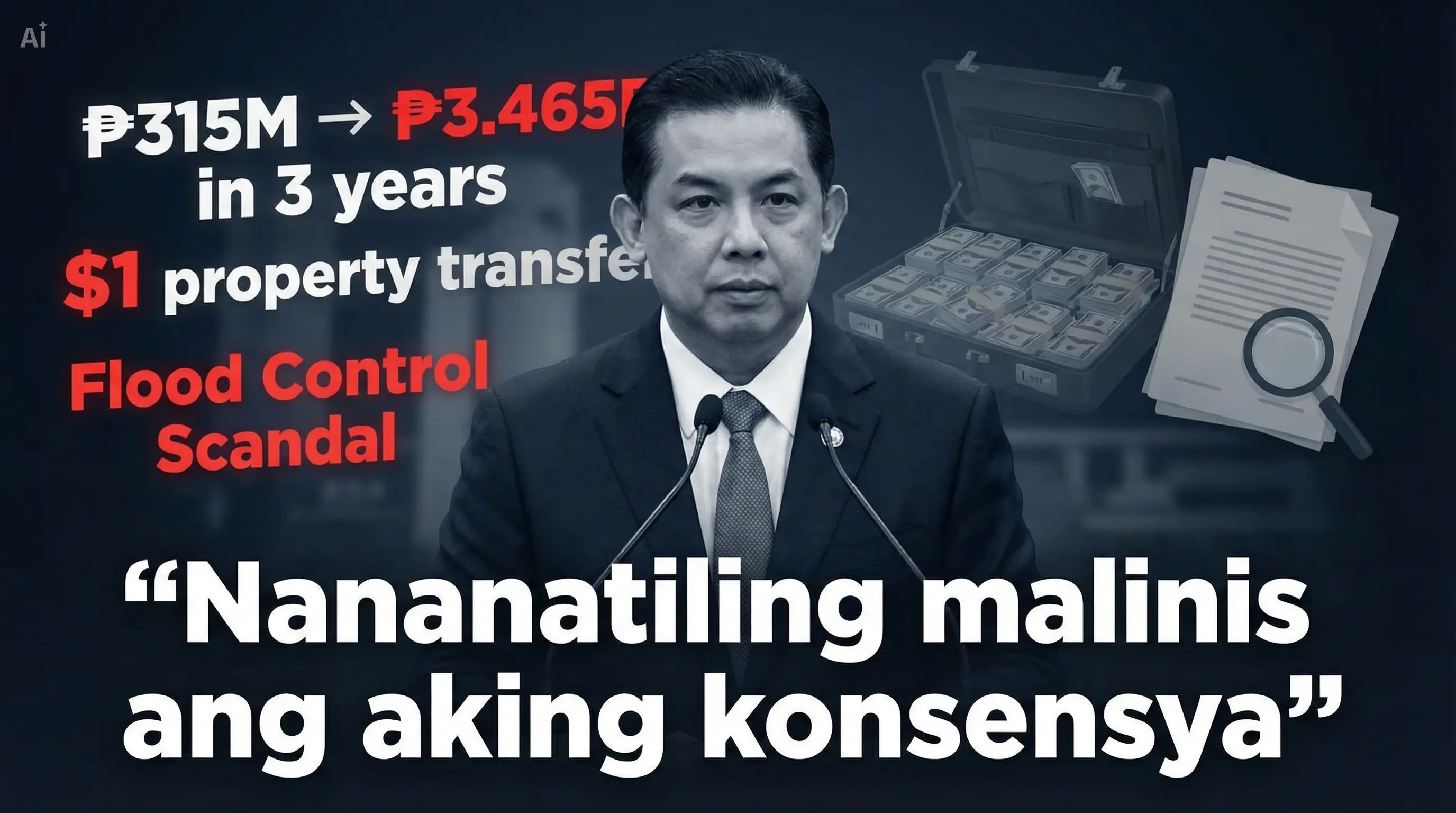
"Uulitin ko — nananatiling malinis ang aking konsensya." (Again, my conscience remains clear.)
That was former House Speaker Martin Romualdez, speaking in front of cameras, composed and unbothered, as allegations of flood control kickbacks continued to swirl around him. It was a masterclass in political confidence — or political deflection, depending on which set of numbers you're looking at.
Because while Romualdez's conscience may be at peace, his Statement of Assets, Liabilities, and Net Worth (SALN) tells a very different story.
From ₱315 Million to ₱3.465 Billion — In Three Years
In 2022, when Romualdez assumed the speakership, his declared net worth stood at approximately ₱315 million. By 2025, that figure had ballooned to an estimated ₱3.465 billion — a staggering 10x increase in just three years, while earning a public official's salary.
To put that in perspective: a House Speaker earns roughly ₱1 million a month in total compensation. Over three years, that's about ₱36 million. The math simply does not add up — not even close.
Davao City OIC Mayor Baste Duterte flagged this publicly: "Ang net worth ni Romualdez noong 2022 ay ₱200 million. Ngayon, ₱3 billion na." Yes, this came from a political rival — but the SALN figures themselves are what demand explanation, regardless of who's pointing at them.
The $1 Property Transfer
It gets more interesting. Rappler's investigative team uncovered that Romualdez transferred a $2.24-million (₱130 million) Massachusetts property — which had been in his name since 1988 — to a corporation called AMMY INC. for the price of exactly $1.
One dollar. For a property worth over a hundred million pesos.
This is a well-known technique for obscuring asset ownership. By transferring property to a corporation for a nominal amount, the asset disappears from personal SALN declarations while the individual retains effective control through corporate ownership. It is legal on its face. It is also a major red flag.
His spokesperson's response? That his SALN is filed and open for review — unlike, they pointedly noted, the Dutertes'.
The Flood Control Scandal: Whose Watch Was It?
This brings us to the most critical question. PCO Undersecretary Claire Castro recently said: "Huwag ipahid kay Pangulong Marcos Jr. ang korapsyon na ginawa mismo ni FPRRD." (Don't connect to President Marcos Jr. the corruption done by former President Duterte himself.)
The problem? The flood control anomalies under investigation largely occurred between 2022 and 2025 — squarely under the Marcos administration, with Romualdez as House Speaker controlling budget appropriations in Congress. Duterte left office in June 2022.
Contractor Curlee Discaya testified directly implicating Romualdez in alleged kickbacks. Another witness, Guteza, claimed he personally delivered suitcases of cash to Romualdez's residence. A minority bloc Senate report found Romualdez liable — either complicit or grossly negligent as Speaker.
The Blue Ribbon Committee ultimately declined to recommend a preliminary probe. The Independent Commission for Infrastructure (ICI) became a source of further confusion when a Tingog Party-list representative claimed it had cleared Romualdez — a characterization the ICI itself immediately denied, saying it "refutes the interpretation."
So to summarize: witnesses testified against him, a Senate minority report found him liable, and the body that supposedly cleared him says it did no such thing.
Malinis pa rin ang konsensya niya.
The Bigger Pattern
What we are watching is not just one politician defending himself. It is a coordinated strategy: deflect blame onto Duterte (a now-convenient enemy), keep the focus on the past administration, and let loyalist spokespeople absorb the public backlash while the principal stays composed behind a podium.
Claire Castro's statement isn't a policy position. It's political theater — rage bait designed to redirect public anger toward Duterte while quietly shielding the current administration from accountability over events that happened on their watch, with their people, using their budgets.
The Filipino public, judging by the 59,000 laughing reactions on Castro's post, isn't fooled.
What Accountability Actually Looks Like
A clean conscience is easy to claim. What's harder — and what the public deserves — is a full, itemized explanation of how a public servant's declared wealth grew by over ₱3 billion in three years. It means explaining every property transfer, every corporate entity, every peso that cannot be accounted for by a government salary.
"Nananatiling malinis ang aking konsensya" is not an audit. It is not testimony. It is not accountability.
It is just a line.
And Filipinos deserve more than lines.