

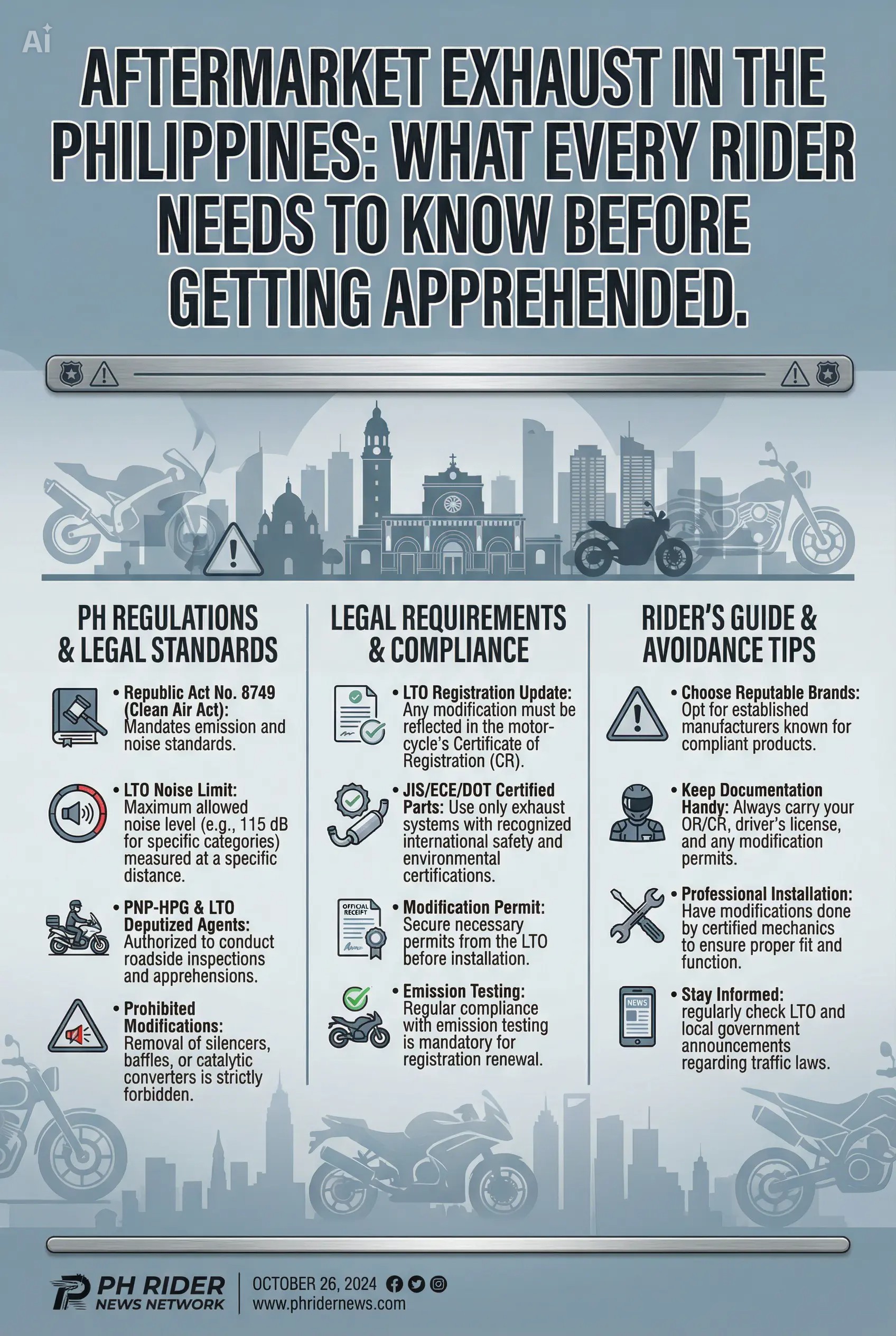
You saved up for months, installed a slip-on or aftermarket exhaust that sounds exactly the way you wanted, passed the noise test at your PMVIC, and figured you were completely safe from apprehension. Then an LTO or PNP-HPG enforcer flags you down on the road, and suddenly none of that documentation seems to matter.
This scenario plays out regularly on Philippine roads. With thousands of motorists and motorcycle riders searching for LTO rules on aftermarket exhaust systems and PMVIC certification for mufflers, widespread confusion remains about what is legally permitted under Philippine transport laws. If you ride a motorcycle or drive a modified vehicle in the Philippines, here is the complete legal breakdown of LTO memorandum circulars, decibel thresholds, PMVIC sound checks, and roadside apprehension rules.
Quick Summary: Are Aftermarket Exhausts Legal in the Philippines?
- Maximum Legal Noise Limit: 99 decibels (dB) measured at 2,000 to 2,500 RPM (LTO Memorandum Circular No. 2020-2240).
- PMVIC Sound Level Test: Required during vehicle inspection. Passing confirms the sound level is ≤ 99 dB at inspection time, but does not grant blanket immunity if physical silencers/baffles are removed.
- Open Pipes: Strictly illegal under RA 4136. Any exhaust lacking a functional silencer, muffler, or baffle is subject to immediate citation and confiscation.
- Slip-on vs. Full Exhaust vs. Side Exit: Legal only if equipped with a certified silencer/catalytic converter and emitting within emissions and 99 dB thresholds.
LTO Rules for Aftermarket Exhaust Systems in the Philippines
The core foundation of vehicle noise and equipment regulation in the Philippines is Republic Act No. 4136 (the Land Transportation and Traffic Code). Specifically, Section 34(j) mandates that every motor vehicle using an internal combustion engine must be equipped with an effective muffler to prevent excessive or unusual noise.
To establish a definitive, enforceable threshold for law enforcement and inspection centers, the Land Transportation Office promulgated LTO Memorandum Circular No. 2020-2240. This regulation standardizes:
- The 99 dB Limit: The maximum allowable sound level for all motor vehicles (cars, motorcycles, utility vehicles, and trucks) is 99 dB(A).
- Measurement Protocol: The sound level is measured using a calibrated sound level meter (decibel meter) placed at a 45-degree angle, 0.5 meters away from the exhaust pipe outlet, with the engine revving at 2,000 to 2,500 RPM.
- Universal Application: The 99 dB cap applies whether the exhaust is OEM, aftermarket, a slip-on pipe, or a replacement system.
PMVIC Certification for Muffler: What Passing the Test Really Means
Private Motor Vehicle Inspection Centers (PMVICs) conduct computerized roadworthiness evaluations, which include sound level meter testing. Many riders ask: "If I have a PMVIC certificate showing my muffler passed at 95 dB, can LTO still apprehend me?"
The short answer is yes, depending on the circumstances. Here is why:
- Point-in-Time Verification: A PMVIC inspection certificate certifies that your vehicle’s exhaust noise was compliant (≤ 99 dB) at the exact date and testing conditions of your inspection.
- No Component Endorsement: The PMVIC certificate verifies noise level; it does not issue an official government endorsement or part-type homologation for an aftermarket brand.
- Roadside Modifications: If removable baffles (dB killers) were inserted for the PMVIC test and subsequently removed on the street, the vehicle is immediately in violation of RA 4136.
While a valid PMVIC inspection result provides strong evidentiary support that your vehicle meets roadworthiness standards, it does not prevent roadside enforcers from conducting a spot check with a calibrated sound level meter if excessive noise is suspected.
Is Slip-on, Full Exhaust, or Side Exit Legal in the Philippines?
The legality of modified exhaust configurations depends on sound suppression, vehicle safety, and emission integrity:
Slip-on Exhaust Legal Must retain functional baffles/silencer and stay within ≤ 99 dB at 2,000–2,500 RPM. Full Exhaust System Conditionally Legal Must maintain proper emissions standards, have an internal muffler chamber, and not exceed 99 dB. Full decat/straight pipes fail inspection. Side-Exit Exhaust Conditionally Legal Exhaust tips must direct fumes away from passenger cabins and pedestrians, satisfy clearance regulations, and meet ≤ 99 dB. Open Pipe / Scari Strictly Illegal No silencer, removed baffles, or straight hollow pipes violate RA 4136 Section 34(j). Subject to fines and impoundment.LTO-Approved Aftermarket Motorcycle Pipes: What to Look For
The LTO does not publish an exhaustive list of approved brand names. Instead, approval is determined by technical compliance. To ensure your aftermarket pipe is legally defensible on Philippine roads, prioritize systems that provide:
- Published Manufacturer Decibel Ratings: Reputable manufacturers specify tested sound levels (dB) across RPM bands.
- Permanent or Secured Baffles (dB Killers): Exhausts engineered with integrated silencing chambers rather than open hollow cans.
- International Road Certification: Systems carrying JMCA (Japan), E-Mark (Europe), or DOT certifications provide documented proof of street-legal noise suppression.
- Certificates of Conformity: Retain the original product specification sheet or safety compliance certificate included with the exhaust.
Legal Grounds for Roadside Apprehension and Penalties
LTO deputized agents, PNP-HPG personnel, and local traffic management units (e.g., MMDA, local city traffic enforcers) enforce exhaust regulations under several distinct grounds:
- Exceeding 99 dB on Calibrated Meter: The quantitative violation under MC 2020-2240.
- Operating an Open Pipe: Modifying or gutting a muffler to operate without noise suppression equipment under RA 4136.
- Local Anti-Muffler Ordinances: Many Local Government Units (LGUs) across Metro Manila and provincial cities maintain stricter local ordinances against noisy exhausts, some enforcing caps lower than 99 dB in residential zones or during nighttime hours.
- Smoke Emission Violations: Full systems that remove the catalytic converter can cause the vehicle to fail Clean Air Act (RA 8749) roadside emission opacity checks.
Fines under RA 4136 and related LTO joint administrative orders typically start at ₱1,000 to ₱5,000, with repeat offenses leading to vehicle impoundment and confiscation of non-compliant exhaust components.
Essential Documentation Every Rider Should Carry
When operating a vehicle with an aftermarket exhaust, keeping proper documentation in your glove box or under-seat compartment significantly reduces roadside disputes:
- Valid OR/CR: Official Receipt and Certificate of Registration confirming active vehicle registration.
- Latest PMVIC Inspection Certificate: Demonstrating that the vehicle passed roadworthiness and sound tests during registration renewal.
- Manufacturer Specification Sheet / Certificate of Conformity: Highlighting the manufacturer’s rated decibel output (≤ 99 dB).
- Receipt of Purchase: Proof of legitimate aftermarket part acquisition.
Frequently Asked Questions (FAQ)
Can an enforcer cite me without using a decibel meter?
For an open pipe where the silencer or muffler has been visibly removed, enforcers can cite a violation of RA 4136 Section 34(j) based on physical equipment absence. However, for disputes regarding whether an intact aftermarket exhaust exceeds 99 dB, LTO guidelines require testing with a calibrated sound level meter under proper measurement conditions.
Do local city ordinances override LTO's 99 dB limit?
LGUs have police powers to enact local noise pollution ordinances within their territorial jurisdictions. While LTO sets the national standard at 99 dB, local ordinances may penalize excessive noise in designated quiet zones (hospitals, schools, residential subdivisions). Motorists must respect both national traffic laws and valid local city ordinances.
Bottom Line
Aftermarket exhausts, slip-on pipes, and replacement mufflers are legal in the Philippines provided they maintain noise levels within the 99 dB ceiling at 2,000–2,500 RPM, retain functional silencing baffles, and comply with clean air emission standards. While passing your annual PMVIC inspection is essential, driving responsibly, maintaining installed dB killers, and keeping your documentation handy are your best protections on the road.